Gear Guide
Equipment You'll Need
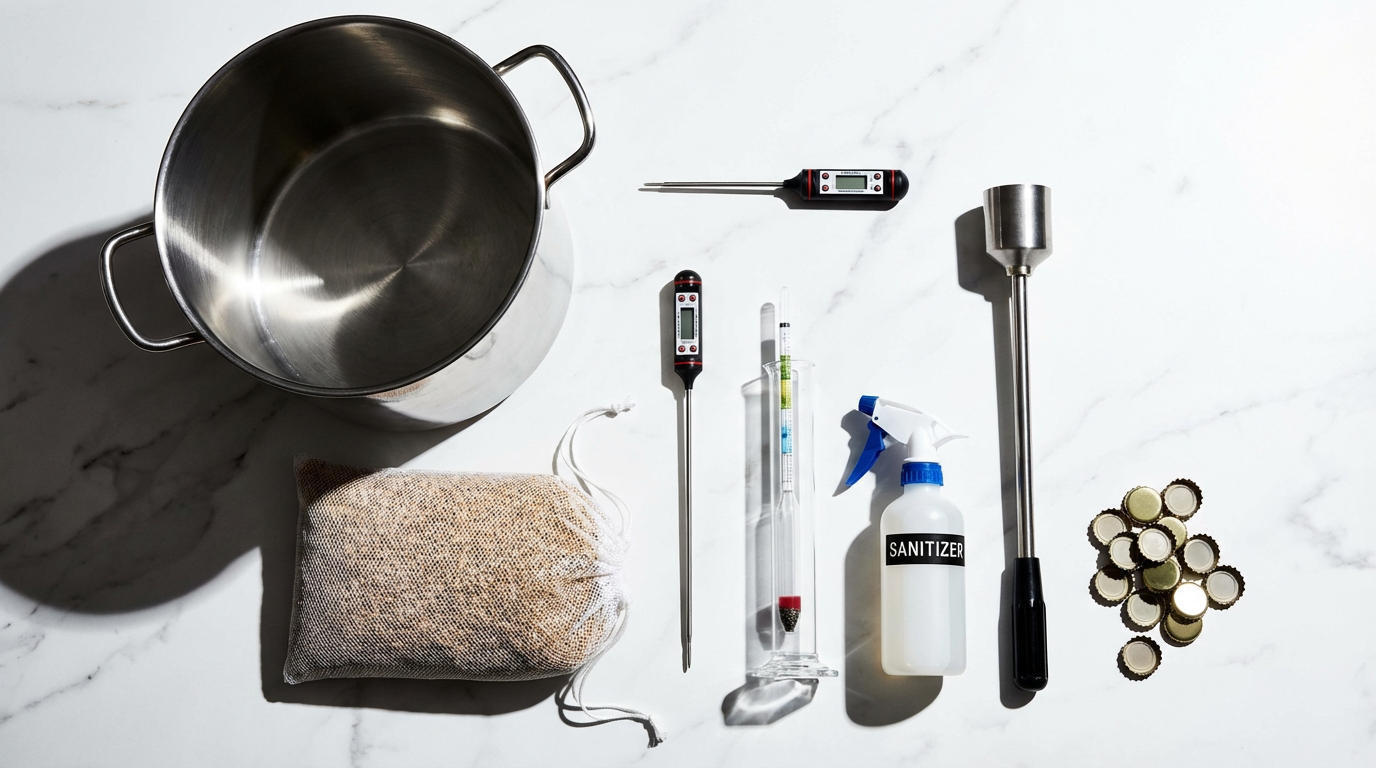
Everything required for 1-gallon BIAB brewing, from must-haves to nice-to-haves.
Everything required for 1-gallon BIAB brewing, from must-haves to nice-to-haves.
You don't need to spend a fortune to start brewing. A basic 1-gallon setup costs $50-100, and you probably already own some of it.
Many homebrew shops sell 1-gallon starter kits that include most of what you need. These are often the best value for beginners. Look for "1-gallon BIAB kit" or "small batch brewing kit."
You cannot brew without these items.
Your main brewing vessel. Everything happens here.
3 gallons for a 1-gallon batch. Bigger is better—gives you room to avoid boilovers.
Budget: $20-30 (aluminum, basic)
Mid-range: $40-60 (stainless steel)
Premium: $80+ (thick-bottom, handles, pour spout)
The "bag" in Brew In A Bag. Holds your grains during mashing.
For a 3-gallon pot: Look for bags around 24" x 26" or similar. Bigger is fine, smaller might be cramped.
Budget: $5-8 (basic paint strainer bag)
Standard: $10-15 (purpose-made BIAB bag)
Premium: $20-30 (heavy-duty with handles)
Accurate temperature control is key to good beer.
A few degrees off during mashing can affect your beer. Digital thermometers are worth the extra cost for accuracy.
Budget: $10-15 (basic digital)
Standard: $15-25 (quality instant-read)
Premium: $30+ (lab-grade, fast response)
Where your beer ferments for two weeks.
You'll need an airlock and drilled stopper (or drilled lid) to let CO2 escape without letting air in.
Budget: $8-12 (glass jug with stopper and airlock)
Standard: $15-20 (better quality, easier to clean)
Premium: $30+ (wide-mouth, PET carboy)
The most important thing you'll buy. Seriously.
Most homebrewers use Star San. It's:
4 oz bottle: $8-10 (makes many batches)
16 oz bottle: $15-18 (lasts forever)
32 oz bottle: $20-25 (lifetime supply)
Do not skip sanitizer. Do not substitute dish soap. One infected batch will convince you forever. Learn more about sanitation →
Where your finished beer lives.
1 gallon = about 10-11 twelve-ounce bottles, or 7-8 pint (16 oz) bottles.
Free: Save from beer you drink
Budget: $10-15 for 12 bottles
Swing-top: $20-30 for 12 bottles
You can brew without these, but your life will be easier with them.
$8-15
Measures sugar content. Tells you when fermentation is done and helps calculate ABV. Can skip if you don't care about the numbers.
$12-20
Makes transferring beer so much easier. One pump starts the flow. Without it, you're trying to start a siphon with your mouth (not sanitary) or pouring (oxidation risk).
$15-25
Required if using pry-off bottles. Not needed for swing-tops. Wing cappers are cheap but handheld. Bench cappers are easier but cost more.
$10-20
For weighing grains, hops, and priming sugar. Essential if you're measuring your own ingredients instead of using a kit.
$5-10
For stirring the mash without burning yourself. Any long spoon works—stainless steel is nice but plastic or wood is fine.
$5-8
Tall narrow container for hydrometer readings. You can use any tall glass but purpose-made ones are easier.
Upgrades that make brewing more enjoyable, but totally optional for beginners.
Cools wort faster than an ice bath. Copper immersion chillers start around $40.
Temperature-controlled box for perfect fermentation. A cooler with frozen bottles works as a budget version.
Track your recipes, notes, and results. A notebook works; brewing apps are nice.
For advanced water chemistry. Not needed for basic brewing.
Measures gravity with just a few drops. Faster than hydrometer but costs more.
Spring-loaded valve for filling bottles. Reduces mess and oxidation.
Sprays sanitizer into bottles. Speeds up bottling day significantly.
Makes your beer look professional. Fun for gifts.
Best selection and often the best prices:
Tip: Many offer free shipping over $50-75.
Worth visiting if you have one nearby:
Search "homebrew shop near me" to find local stores.
Convenient for basic equipment:
Best for general equipment. Buy ingredients from homebrew shops.
Good for basics:
Download our printable equipment checklist to bring to the store.
Download Checklists